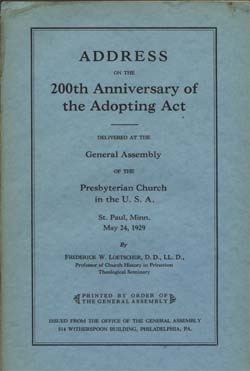
Historic Documents in American Presbyterian History ADDRESS ON THE
We celebrate today the bi-centennial of the adoption of the constitution of our Church. Like many another historic fact which a grateful posterity delights to commemorate, the event to which our attention is directed by the exercises. of this hour was the achievement of a small group of men, most of whom were little known beyond the regions where their daily work was being done, and not one of whom could foresee the far-reaching consequences of their united action. But few in number though they were, inconspicuous as was the scene of their joint endeavors, feeble as was the young but growing Church which they represented, and trivial as their doings may have seemed to the casual observer who had no eye for spiritual values, 'these ministers and elders of the General Synod appear to us today, as they have to generations of Presbyterians before us, as veritable heroes of the faith, transfigured to our view by the glory of the great cause of revealed truth which they served, and which in turn largely made them what they were. Under circumstances that were destined to give a world-historical importance to their deed, they ventured on a high resolve, the beneficent influence of which has become increasingly clear through the two centuries that have elapsed since those memorable days in September, 1729, when in the city of Philadelphia—hallowed even then as the place where organized American Presbyterianism had come to its birth—the Synod unanimously adopted as its constitution the Westminster Confession of Faith, Catechisms, and Directory. By way of commemorating this notable event let us first consider the nature, and then the historical significance, of the so-called Adopting Act. The first American classical Presbytery was formed in the spring of 1706. In 1716 it transformed itself into a Synod, there being at that time seventeen ministers, about forty congregations, and about three thousand communicants. From the Adopting Act itself, as well as from other contemporaneous evidence, it is clear that the Westminster standards had never been formally acknowledged by either the Presbytery or the Synod, though both had made occasional references to a certain "Presbyterian constitution" and its "rules." But whatever these regulative principles may have been, there can be no question that from the very beginning these ministers accepted one another as true Calvinists; that as regards the form of church government, they were almost to a man Presbyterian, not only by birth and training,, but also by conviction; and that in their corporate capacity they regularly made use of all the powers commonly exercised by the highest governing body in Churches of the Reformed type. We learn, further, that candidates were admitted to the sacred office, and ministers were received from other communions, not by subscribing the Westminster Confession, but by satisfying the Presbytery or the Synod of their fitness to become members, either by sustaining an examination or by furnishing suitable testimonials from the Churches, mostly foreign, from which they came. For a time this double method of guarding against the entrance of undesirable ministers was admirably effective. But ere long increased caution was deemed necessary. To understand the change in the Synod's policy, we must glance for a moment at the condition of the Protestant and espeially the Presbyterian Churches of the British Isles during the first decades of the eighteenth century. I can only allude to a few of the salient and typical facts. In England, Deism was rapidly coming to the height of its baleful influence. Both in the Establishment and among Dissenters, anti-Trinitarian views were widely disseminated. In 1702, Thomas Emlyn, of the Dublin Presbytery, openly avowed his Arianism. His example was followed a little later by Joseph Hallett and James Peirce, of Exeter. In 1705, John Abernethy, of Antrim, founded the Belfast Society of Presbyterian ministers, which became a stronghold of doctrinal indifferentism and of determined opposition to all subscription of creeds. In 1714 and again in 1725, Professor Simson of Glasgow, under whom many of the young Irish pastors were studying theology, was tried on various charges of heresy. Thus alike in England, in Scotland, and in Ireland, the witness of the Presbyterian Churches was being impaired. Indeed, their very existence was at stake. Swift and ever swifter was the downward course from Calvinism through Deism, Arianism, and Socinianism, to Unitarianism, Arminianism, and the sheer Naturalism that professed to find in Christianity only a republication of pagan morals. Most deplorable of all was the state of the Irish Presbyterian Church. One after another its compromise measures had failed. The Pacific Act of 1720 had still insisted on subscription of the Confession of Faith, but virtually, as the ambiguous phrase read, only "for substance of doctrine." Finally, in 1726, the Synod of Ulster declared its inability to continue ministerial fellowship with the Non-subscribers, who thereupon withdrew and formed themselves into the independent Presbytery of Antrim. The American Presbyterians were perforce keenly intersted in these dissensions of their British brethren, and especially in the disruption of the Irish Synod. For the immigration from the North of Ireland to the colonies was constantly on the increase, and it was altogether likely that the disturbances in Ulster would soon be finding their way to these shores. One fact at least was plain: ministerial credentials from abroad could no longer be safely taken at their face value. Under these circumstances, what could the Synod of Philadelphia do to protect its fundamental principles of doctrine and polity? As early as 1724 the Presbytery of New Castle had made subscription of the Confession obligatory upon all its candidates for licensure. And it was a minister of this judicatory, John Thomson, pastor since 1717 of the church of Lewes, Delaware, who presented to the Synod of 1727 an overture recommending not only adoption of the Westminster Standards by the Synod, but also subscription or equivalent acknowledgment by all candidates for the ministry and by all entrants from other communions. Some of the Welsh and native American members strenuously opposed the use of any creed as a test of orthodoxy. But the measure was again brought forward in 1728 and so strongly supported by the Scotch and Irish that, had they chosen to do so, they could have secured its adoption. But the majority, hoping that by showing a conciliatory spirit they might attain their end without rending the Church asunder, agreed to postpone the question till the next Synod, which, it was decided, should be a full and not a delegated body. A judicially chosen committee, to whom the Synod of 1729 referred the subject, brought in a unanimous report, which after long discussion was adopted without a dissenting voice, at the morning session on the nineteenth of September. This celebrated declaration, which like its prototype, the Irish Pacific Act of 1720, was manifestly a compromise and as such not altogether free from ambiguities, is commonly referred to as the Adopting Act. But much confusion would have been avoided, not only at that time but on many later occasions, if the distinction had been carefully observed which the Synod itself made between this declaration, which it called merely its "first or preliminary act," and that which it called the Adopting Act. The Adopting Act, properly considered, consists of two parts, one approved on the afternoon of that same September nineteenth, and the other on the morning of the twenty- second. The former, dealing with the doctrinal standards, is the more important. It reads: All the ministers of this Synod now present, except one that declared himself not prepared . . . after proposing all the scruples that any of them had to make against any articles and expressions in the Confession of Faith and Larger and Shorter Catechisms of the Assembly of Divines at Westminster, have unanimously agreed in the solution of those scruples, and in declaring the said Confession and Catechisms to be the confession of their faith, excepting only some clauses in the twentieth and twenty-third chapters, concerning which clauses the Synod do unanimously declare, that they do not receive those articles in any such sense as to suppose the civil magistrate hath a controlling power over Synods with respect to the exercise of their ministerial authority; or power to persecute any for their religion, or in any sense contrary to the Protestant succession to the throne of Great Britain. And the second part of the Adopting Act, dealing with the Directory, reads as follows: The Synod do unanimously acknowledge and declare, that they judge the directory for worship, discipline, and government of the church, commonly annexed to the Westminster Confession, to be agreeable in substance to the word of God, and founded thereupon, and therefore do earnestly recommend the same to all their members, to be by them observed as near as circumstances will allow, and Christian prudence direct. We have been considering the Adopting Act in the light of the conditions that occasioned it. These sufficiently reveal its general nature and its primary purpose. But what was the specific intent of this legislation? We here raise one of the most important questions within the whole realm of our denominational history through two centuries. Again and again, especially in times of theological controversy, it has emerged as the fundamental problem in our constitutional government. We need to inquire, in what sense these standards, particularly the Confession and Catechisms, were adopted. What, precisely, were the doctrinal obligations which those ministers took upon themselves, and which they resolved to impose henceforth as terms of ministerial communion? There were in the Synod three forms of opinion on the subject of creed-subscription. In the first place, there was the view of those who advocated an absolutely unqualified acceptance of the Confession; not only of every article, but of every proposition. Their chief representative was Alexander Craighead, who later left our Church and became a Cameronian, mainly because he regarded the prevalent interpretation of the Adopting Act as an inadequate acknowledgment of the Confession. The second view was that of another small group, best represented by the ablest and most influential member of the Synod, Jonathan Dickinson. Their chief contention was that there should be no distinction between doctrinal requirements for church membership and those for ministerial communion, but that for the one as for the other simple agreement in "the essential and necessary articles of Christianity" should be deemed sufficient. The third view, which finally was supported by all present when "the preliminary act" was passed, and likewise by all present when the Adopting Act was passed—excepting Mr. Elmer, who later also acceded—was the view that the adoption of the Confession and Catechisms meant the adoption of their "system of doctrine"; neither, therefore, the acceptance of every statement which they contain, nor the acceptance merely of the fundamental Christian truths which they contain, but the acceptance of that "system of doctrine" which they contain—the Reformed or Calvinistic system, which the original Presbytery had from the beginning tacitly, though never formally, acknowledged. That this via media truly expressed the mind of the Synod cannot be doubted. We can cite only a few of the more important testimonies. The "preliminary act" had referred to the possibility that some ministers might have scruples with respect to what were styled "articles not essential and necessary in doctrine, worship, or government." So the question naturally arose as to how much of the Confession was actually to be acknowledged. As the event proved, no member had any scruples about anything in the Confession except certain clauses in the twentieth and twenty-third chapters, and in the Adopting Act proper the Synod unanimously agreed in the solution of these scruples by rejecting certain unwarranted interpretations of those clauses. The deliverance of 1730 is unmistakably clear: The Synod do now declare that they understand those clauses that respect the admission of entrants in such a sense, as to oblige them to receive and adopt the Confession and Catechisms at their admission in the same manner and as fully as the members of the Synod did that were then present. But evidently the wide circulation of the original overture, unaccompanied by the text of the Adopting Act proper, was still causing anxiety. Accordingly, the Synod in 1736 unanimously made a new public avowal concerning the Adopting Act and its relation to the "preliminary act": The Synod have adopted and do still adhere to the Westminster Confession, Catechisms, and Directory, without the least variation or alteration, and without any regard to said distinctions (i.e., those in the "preliminary act," concerning essential and non-essential articles). And we do further declare that this was our meaning and true intent in our first adopting said Confession. There is ample testimony that the Presbytery faithfully adhered to the Adopting Act as thus interpreted by the authority that ordained it. And during the Schism between the Old and the New Sides, 1741 to 1758, both parties reaffirmed their loyalty to the doctrinal system set forth in the Confession. When the two Synods reunited, they testified that they had always regarded the Confession "as an orthodox and excellent system of Christian doctrine." And when the General Assembly was organized in 1788, the new constitution in no sense altered the doctrinal obligation of candidates for the ministry, but only gave it still more explicit form in that familiar question to which, ever since, an affirmative response has been required of all seeking ordination as ministers, elders, or deacons in our church: "Do you sincerely receive and adopt the Confession of Faith of this Church, as containing the system of doctrine taught in the Holy Scriptures?" Thus it has come to pass that throughout the two centuries of her history, whatever revisions and amendments of her standards she has deemed necessary, our Church has always officially maintained the Calvinistic system of doctrine, the Presbyterian form of government, and the principles of worship and discipline that have characterized the Churches of the Reformed Faith. And now, in the light of these facts, let us briefly consider the historical significance of the event we are commemorating. From one point of view, indeed, the Adopting Act may seem to have been little more than a bare formality; revealing, no doubt, considerable skill, tact, and courage in the handling of a grave ecclesiastical question; but calling for none of those higher gifts of constructive thinking which distinguish the labors of the most illustrious of the so-called ecumenical councils. But when we look at the substance of this Act, and especially when we undertake an estimate of what these standards have meant not only to our Church but also to our nation and the world, we cannot but see in the Synod's timely adoption of them a reflection of that same spiritual wisdom which had enabled the Westminster Assembly of Divines to produce these incomparable works of religious and theological genius. I realize that such a characterization of these venerable documents will appear to many, even among those whom I have the honor of addressing on this occasion, as an unwarranted exaggeration, if not a sheer anachronism. For the fashion of the day minimizes the value of all creeds, and our Confession, like many others, must often undergo the sorrowful experience of being damned with faint praise even in the home of its reputed adherents. Many Presbyterians, to be sure, still profess keen admiration for what we may call the by-products of our Reformed Faith—its beneficent ethical and social fruits—but have little or no regard for those great doctrinal principles that have ever been the root and trunk, nay the very sap and life, of historic Calvinism. We need to remember, therefore, that it is only as we take our constitutional standards in their vital relations to one another as members of a single living organism, that we can hope to appraise them, individually or collectively, at their true worth. First of all, then, let us view the Adopting Act in relation to the primary duty of the Christian Church, that of bearing witness to the revealed truth of God. No doubt, had it chosen to do so, the Synod could have fashioned an entirely new creed that would have been worthy of the best traditions of modern Protestantism. But this was neither necessary nor desirable, and our venerated fathers, deeply conscious of the value of their God-given heritage of faith, evinced their superior wisdom by frankly appropriating for their doctrinal platform the Westminster Confession and Catechisms: those noblest products of the great reliious revival that we call the Reformation; those matchless formularies which at least English-speaking Christendom had come to regard as the most comprehensive, precise, and adequate embodiment of the pure gospel of the grace of God, and which a distinguished authority of our own day— I refer to my late colleague, Dr. Benjamin B. Warfield— described as "the most complete, the most fully elaborated and carefully guarded, the most perfect, and the most vital expression that has ever been framed by the hand of man, of all that enters into what we call evangelical religion, and of all that must be safeguarded if evangelical religion is to persist in the world." Time will not permit even a cursory analysis of the many excellencies of these historic symbols. But it may be well, by way of correcting a prevalent misconception as to the scope and content of what we familiarly call our Calvinistic system of faith, to emphasize the fact that our Confession really embraces three classes of doctrines; first, those which are common to all Christians, and which were anciently set forth in the Apostles', the Nicene, and the Athanasian Creeds; secondly, those which Protestants hold as over against the Roman Catholics; and thirdly, those which distinguish the Reformed Churches from the Lutheran, principally in the matter of the sacraments, and from the Arminian, in those characteristic five points which were rejected by the Remonstrants but affirmed by the Synod of Dort. Accordingly, among competent students of theology there has never been any serious question as to the admirable comprehensiveness, proportion, and balance of these celebrated standards of doctrine. But if we would fully grasp their unique influence on religious thought—that realm of life with which they were most directly concerned, and which we are specially considering just now—we need to weigh the significance of the fact that nowhere in the history of Christianity has the evangelicalism of the Bible been proclaimed with greater thoroughness, circumspection, and accuracy, against those two basal perversions of the gospel which are continually menacing the Church from within: the sacerdotalism that conditions salvation on the activities of a man-made priesthood; and the humanism which, however much it may honor the name of Christ, robs him in whole or in part of the glory of his Saviourship by denying the necessity or the sufficiency of His grace as the one and only hope of sinful men. The first Reformers had, indeed, begun to break the despotism of the Roman hierarchy; but it was only after the Puritans carried the contest to a finish in their hard-fought battle against prelacy in the Reformed Church of England, that the gospel was at length freed from the encroachments of every unwarranted ecclesiasticism. And while we gratefully recognize the ability and skill of those who defended the faith against the first attacks of the Socinians, it is again to the Westminster Divines that the world is indebted not only for the casting out of the last dregs of Semi-Pelagianism, but for the clearest and richest presentation of the biblical message that our salvation is due altogether and solely to the unmerited favor of God in Christ Jesus. Herein, then, lies the significance of one aspect of the Adopting Act: not only was our Church made once for all a confessional Church, but her official and corporate witness was specifically pledged in behalf of that Confession of Faith which was the noblest achievement of the best period of British Protestantism; to that historic Calvinistic system of doctrine which more adequately than any other formulary ever composed unfolds to us, and guarantees for us, the truly theistic view of the natural and spiritual worlds; the meaning of religion in its highest possible conception; and evangelicalism in its purity and integrity. I mention as a second noteworthy result of the Adopting Act the contribution which our Church has made to the cause of religious and civil liberty. And in this connection, I would emphasize, first of all, the generous measure of liberty which our ministers enjoy under our constitutional standards. Consider, for example, their conduct of public worship. They are bound by no prescribed liturgical forms, but have the utmost freedom in following the general principles recommended in the Directory. Moreover, as we have already seen, they are not required to accept the ipsissima verba of the Confession, but only its system of doctrine as such. A considerable diversity alike in opinion and in practice has always been allowed with respect to many statements in the Confession on topics pertaining to the Church, the State, and our social relations. One is not guilty of breaking his ordination vows, if he does not believe that there are two classes of presbyters, or that desertion is a valid ground of divorce, or that every true Christian should be admitted to sealing ordinances. But even within the limits of the doctrinal system itself, our standards permit various explanations of such basal facts as the inspiration of the Scriptures, God's providential control of the world and human life, original sin, inability, the atonement, and the millen[n]ial reign of our Lord. Our irenic and moderate Confession leaves room for both Infralapsarians and Supralapsarians, for both Creationists and Traducianists, for both Old School and New School Presbyterians. But let us turn to the main consideration. The fact is as familiar as it is striking that ever since the Protestant revolt against Rome gave the modern world its first taste of genuine religious liberty, the nations that have achieved and enjoyed the greatest freedom have been those which have been most fully brought under the influence of Calvinism. The reason is not far to seek. This system of thought, in the imposing form which Calvin gave it in his Institutes, intensifies to the utmost those principles of revealed truth that make men free: the fear of God that casts out all other fear; the divine grace that humbles all sinners alike before the face of the Eternal, and offers salvation to all upon exactly the same terms; the idea of predestina- tion, that exalts the lowliest believer with a sense of his high calling in Christ Jesus and sustains him under the scorn and contempt of earthly superiors; the teaching that God alone is lord of the conscience, and that, while the civil magistrate is to be obeyed in all his lawful commands as a minister of God ordained to serve the public good, he is to be resisted and, if need be, deposed, if he violates the Christian's supreme obligation to God and the divine will revealed in the sacred Scriptures. These are some of the tributaries of that life-giving stream of equality before God and democracy among men, which Calvinism has made to flow over all the broad plains of modern history. "Man over men, And on the other hand, we must take into account the characteristics of Presbyterianism as that form of polity in which the doctrines of Calvinism have ever found their most natural and influential embodiment: the independence of the Church under the sole headship of Christ; the parity of the clergy as against every hierarchy, whether papal or prelatical; the right of the Christian laity to participate, through its chosen representatives, in the government of the Church; and the maintenance of strict discipline over all members by presbyteries of teaching and ruling elders. No doubt, both Calvin and the Westminster Divines failed to effect that complete separation between Church and State without which the former cannot make full use of her divinely guaranteed autonomy in purely spiritual affairs. Nor may we forget that even among the Puritans of the seventeenth century, those foremost champions of popular liberty, the practice of religious toleration lagged far behind the logic of their convictions. But imperfect as was the freedom of their Church under the authority of Parliament, their principles were destined to bear beneficent fruit, most abundantly in our own country first of all, then throughout the English-speaking nations, and more recently in Europe, where one by one the scepters of autocracy have been hurled into the dust. It is, therefore, to that Adopting Act which made the Westminster Standards, cleansed of their original Erastian- ism, the constitution of what has become the largest Presbyterian Church in the world, that we may justly ascribe the greatest contribution that Christianity has yet made to the cause of human freedom. That famous deliverance, by its denial of the power of the civil magistrate to control Synods in "the exercise of their ministerial authority" or "to persecute any for their religion," is the first declaration, by any ecclesiastical body on American soil, of what has, now become the almost universally accepted view of the right relation of Church and State—"a free Church in a free State." How Presbyterians behaved, and what they, accomplished in the struggle of the colonies for independence, is too familiar to need repetition on this occasion. Suffice it to say that two-thirds of our Revolutionary forefathers were men trained in the school of Calvin, the majority of them being Presbyterians, and that without exception the ministers of the Synod were devoted to the patriotic cause. The historian Bancroft speaks of this war as "the natural outgrowth of the principles which the Presbyterianism of the Old World planted in her sons, the English Puritans, the Scotch Covenanters, the French Huguenots, the Dutch Calvinists, and the Scotch-Irish Presbyterians of Ulster." But even more important than the fight for freedom was the establishment of the Federal Union. No doubt, denominational pride has at times led some Presbyterians to make undue claims in behalf of their form of government as the model for that of the United States. But whatever may be said of the similarities and the differences between the two constitutions, both were the result of those ideas of representative popular government of which our Synod was the outstanding illustration and the most influential advocate throughout the colonial period. In this profound sense we may still endorse the weighty judgment of von Ranke, that Calvin was virtually the founder of the free states of North America. But we must look even beyond the wide domain of our national life, if we would gauge aright the historic significance of our polity. We need to remember that today Protestantism the wide world over is becoming Presbyterian, not indeed in name, but in substance: one by one the great denominations of our own and other lands have been learning to follow in the footsteps of that humble and solitary Presbytery of Philadelphia, which has given our Church her unique distinction of being the first in America to administer her affairs by a representative council of clerical and lay members voting equally. And when to this signal fact we add the achievements of the General Synod in securing full religious liberty for ecclesiastical bodies, and in developing free institutions under a republican form of government, we may safely say that our Confession, whatever may be its future, will never become, any more than it has ever been, the creed of a political despot, or a priest-ridden Church, or an enslaved people. Another significant result of the Adopting Act was the deep interest which our Church, like all others committed to the principles of Calvinism, was bound to take in the cause of education. Of the seven ministers of the original Presbytery, six were graduates of universities or colleges. And the fathers of the Synod, convinced that in the long run piety without learning is about as injurious as learning without piety, did their utmost to maintain the traditionally high standards of the Reformed Churches in regard to ministerial training and culture. Moreover, true to the genius of their system of doctrine, their type of public worship, and their form of ecclesiastical government, they exalted the teaching function of their office, not only in the sermon and the mid-week lecture, but also in the catechetical class and the Sunday school, always putting the emphasis, not upon considerations of mere taste or sentiment, but upon the systematic and thorough inculcation of biblical truth addressed to the understanding, the conscience, and the will. In this fact we find one of the main reasons of the unprecedented influence of Calvinism upon civilization. But we may not confine our attention to the sphere of purely religious education. Presbyterians have not been builders of cathedrals, but they have been builders of colleges. Indeed, in all our denominational life there is no more inspiring chapter than that which records the ever-expanding work of our institutions of higher learning. Tennent's Log College on the Neshaminy, and the many schools that have made it their model, are an increasingly impressive memorial of the devotion of our Church to the cause of education. And it is to Calvinistic Scotland and Holland that we owe our system of common schools supported at the public expense, the most distinctive, as it is the most beneficent, feature of American educational enterprise. Like the Puritans of New England, the Huguenots of the South, the German Reformed of Pennsylvania, and the Dutch of New York, our Presbyterian forefathers "all brought the Church, the Bible, and the schools with them." That is why our American Calvinism never "Dreads the skeptic's puny hands, he significance of the Adopting Act is revealed in yet another aspect, when we survey the evangelistic and We have been considering the significance of the Adopting Act in the light of some of the outstanding achieve- ments of our Church during the two hundred years of her history under this constitution: her faithful witness to the pure gospel of the grace of God; her service in behalf of religious and civil liberty; her contribution to the cause of education; and her evangelistic and missionary labors at home and abroad. But no such analysis can fully disclose all that the Westminster Standards have meant to a body of Christians second to none in intelligence of conviction, fidelity to the truth, and zeal for the honor of God and the glory of His kingdom on earth. So we needs must come at last to that larger synthesis that views life in the sum of its qualities and the totality of its influences. And here assuredly, whatever may be said of the low ebb of our Calvinistic faith and practice in these latter days, we have no reason to be ashamed of. our ancient heritage. Our too optimistic essayists and our sentimentalizing preachers may find it a congenial pastime to heap ridicule upon this or that detail of the Puritan's way of life, but alas! they are unable to restore strength and firmness to the enfeebled conscience of our day, that is suffering from a double spiritual poverty—the faded sense of the holy majesty of the only true and living God, and the all but vanished sense of sin and the need of an atoning Saviour. But as Dr. Kuyper well reminds us: "The persuasion that the whole of a man's life is to be lived as in the divine presence" is the secret of those marvelous moral transformations wrought by Calvinism, "which in one generation, though hunted from the battlefield to the scaffold, created, through five nations at once, wide serious groups of noble men, and still nobler women, hitherto unsurpassed in the loftiness of their ideal conceptions and unequalled in the power of their moral self-control." To the same effect is the testimony of Mr. Froude, which is all the more impressive in view of his lack of sympathy with the evan- gelical principles that underlie the Calvinism he so highly praises: "When all else has failed—when patriotism has covered its face, and human courage has broken down—when intellect has yielded, as Gibbon says, 'with a smile or a sigh,' content to philosophize in the closet, and abroad worship with the vulgar—when emotion, and sentiment, and tender imaginative piety have become the handmaids of superstition, and have dreamt themselves into forgetful- ness that there is any difference between lies and truth— the slavish form of belief called Calvinism, in one or other of its many forms, has borne ever an inflexible front to illusion and mendacity, and has preferred rather to be ground to powder like flint than to bend before violence or melt under enervating temptation." We Presbyterians of today may have some difficulty in recognizing ourselves in these eulogistic descriptions of our spiritual ancestors; but this at least we dare affirm, that no members of any Church have ever had a worthier ideal of character and conduct set before, them than that presented to us in that deep and searching word of our Form of Government: "truth is in order to goodness; and the great touchstone of truth, Of all the standards adopted by the Synod two centuries ago, only the Shorter Catechism, that matchless compendium of biblical teaching, has been kept unaltered. The Directory as revised in 1788 became largely a new work. The Confession has been repeatedly amended, and no doubt further changes will be made in time to come. But our celebration this morning will fall far short of what it ought to be, unless we, and the great Church we represent, find in an occasion like the present a fresh incentive to increased loyalty to those essential principles of Calvinism that have been our glory in the past, that abide in their integrity and vigor through all their changes in form and accent, and that still inspire our best hopes for the years that lie before us. I am well aware of the conditions that fill many, even among our Presbyterian leaders, with grave misgivings as to the future of evangelical Christianity. There is that deep-rooted and wide-spread Naturalism that from the days of the English Deists, the French Encyclopedists, and the German Rationalists has with growing intensity been affecting all philosophy, science, politics, history, and religion. There is the consequent destructive biblical criticism that is robbing us of the Christ of God and leaving us a mere man or, worse still, a helpless paranoiac. There is the neo-paganism that with all its intellectual brilliance and its refined manners is more hostile to the supernatural gospel than is the gross idolatry of darkest heathenism. And there is that illusive new theology that still uses the language of Zion but puts a different meaning into all the cardinal terms, that now— "palter with us in a double sense: It is no wonder that our age, distraught by its very knowledge, irreverent to antiquity, impatient of creeds and dogmas, intolerant alike of human and of divine authority, overborne by the currents of atheistic Naturalism and pantheistic Evolutionism, is directing its heaviest artillery of unbelief against Calvinism as the strongest citadel of supernatural revelation and redemption. And as Professor Henry B. Smith prophesied a generation ago: "One thing is certain—that infidel science will rout everything excepting a thorough-going Christian orthodoxy." Let us, then, resolutely accept this challenge. For of a truth it is none other than the voice of God calling to the Church of our day: "Awake, awake; put on thy strength, 0 Zion; put on thy beautiful garments, O Jerusalem, the holy city." And let us be of good cheer; for Calvinism can no more perish from the earth than sinful man can utterly lose his sense of dependence upon God, or the Almighty can abdiate the throne of His universal dominion. Let us confidently face the tasks that providence is laying to our hands, and let us put our trust, not in our own resources, but in the sovereign might and grace of Him to whom alone belongs the divine prerogative of quickening men into newness of life and making them able and willing to do His good pleasure. |